
We supplement children's education through dietary education support.
We run dietary education programs as part of our mission to contribute to food culture and society through great taste and excitement.
Message from the Dietary Education Support Office
We hope that many children will deepen their interest in food.
We hope that they enjoy food without wasting any.
These programs were created with such desires in mind. Prima Meat Packers Group supports and respects United Nations and International Labour Organization (ILO) conventions concerning the rights of children, and supports children’s healthy growth and right to learn through dietary education activities.
For this dietary education support project, we have prepared three programs: “Let’s Eat Breakfast,” “The Secrets of Preserved Foods,” and “Let’s Take a Peek in the Refrigerator.” We invite you to make use of them in your school classes.
Types of programs
Dietary Education Materials and Onsite Class Program: “Let’s Eat Breakfast”
For this dietary education support project, we provide the teaching material “Let’s Eat Breakfast” in electronic format (PowerPoint or PDF) in quantities matching the number of children. Using our company characters and group work, the material enables children to enjoy learning about the role of breakfast and about nutritionally balanced meals consisting of a staple food, main dish, and side dish.
You may choose either the PowerPoint format, which is convenient for lesson facilitation and customization, or the PDF format, which is suitable for distribution and printing. As the material is provided as electronic data, it can be used directly for distribution to children’s tablets or for printing. We also offer onsite classes led by our instructors upon request.
- *Please note that we may not be able to accommodate all requests for onsite classes if the number of applications exceeds capacity.
Dietary Education Materials: The Secrets of Preserved Foods
We offer an educational PowerPoint presentation titled The Secrets of Preserved Foods, which schools can give to each student. By viewing the material, students will learn about the history of preserved food and how it is made, gaining an appreciation of the importance of food and how it should not go to waste.
Onsite Class Program "Let's Take a Peek in the Refrigerator"
This is an Onsite Class Program in the form of a quiz utilizing slides. Our instructors can visit your school and provide this lesson. This is a fun way to learn how to preserve food and gain basic knowledge about food labels.
Program features
This program is linked to the study content of school subjects.
The materials have been developed according to units within Social Studies and Home Economics, so they can be used directly in such classes. (Target grades: Upper elementary grades; 5th to 6th grade)
The content is designed to be covered in a short amount of time so that it can be easily incorporated into the timeframe of a school class.
How to apply
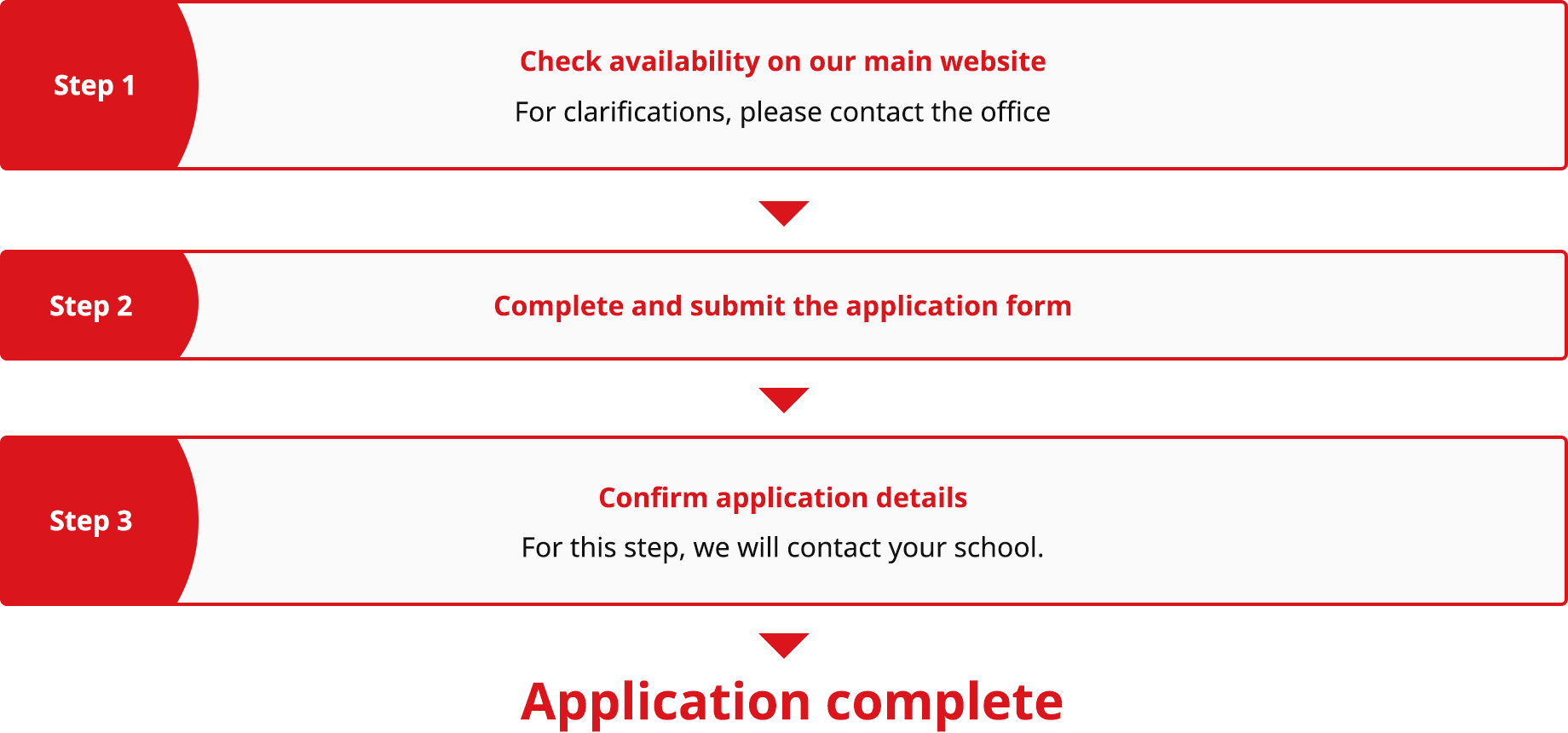
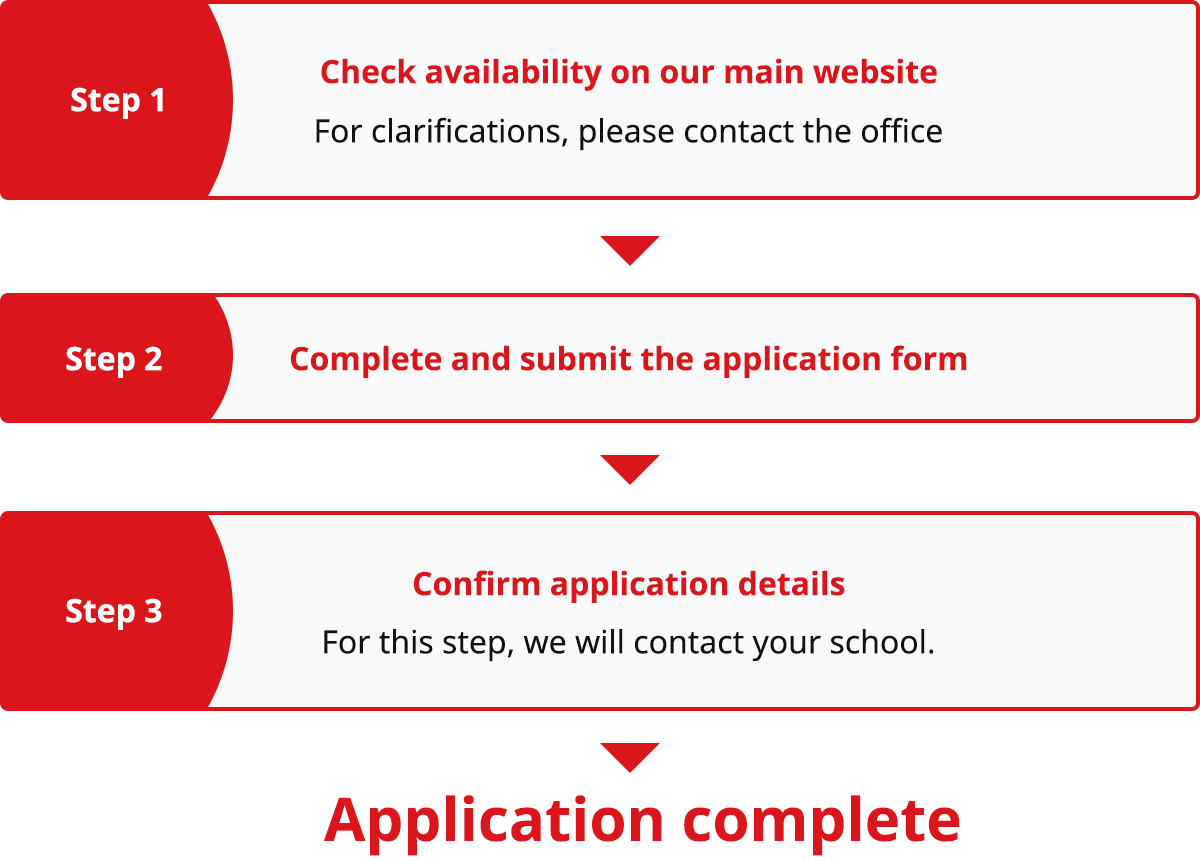
You can email us here (the email is also shown at the bottom of this webpage).
Introduction to Each Program
Dietary Education Materials and Onsite Class Program: “Let’s Eat Breakfast”
This is a set of dietary education materials provided in electronic format (PowerPoint or PDF). Using our company characters and group work, the materials help children enjoy learning about the role of breakfast and about nutritionally balanced meals consisting of a staple food, main dish, and side dish.
You may choose either the PowerPoint format, which is convenient for conducting and customizing lessons, or the PDF format, which is ideal for distribution and printing. Because the materials are provided in electronic form, they can be used as is for distribution to children’s tablets or for printing.
In addition, upon request, we also offer onsite classes led by our instructors.
This teaching material is designed so that teachers can freely select the slides to be used according to class time and purpose. It can be used flexibly for everything from a short morning study session to a full 45-minute class.
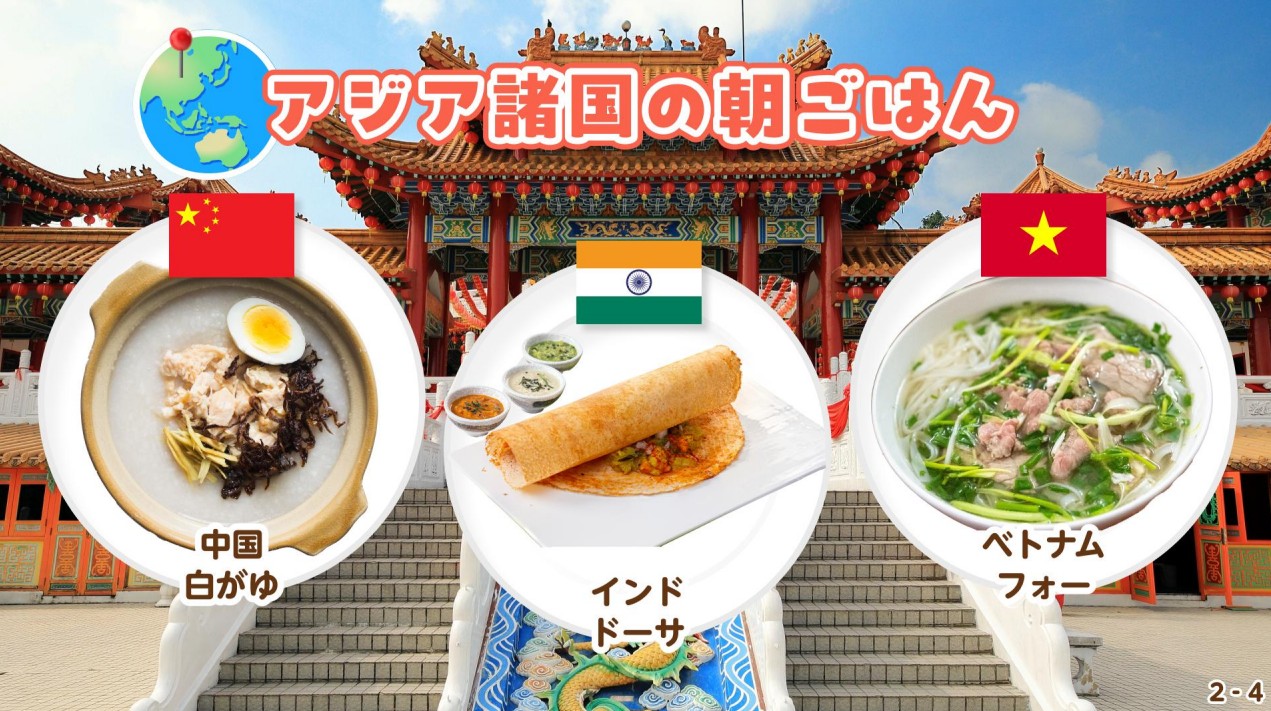
- 1Let’s Take a Look at Breakfasts Around the World
As an introduction, this section presents breakfasts from various countries with photos.
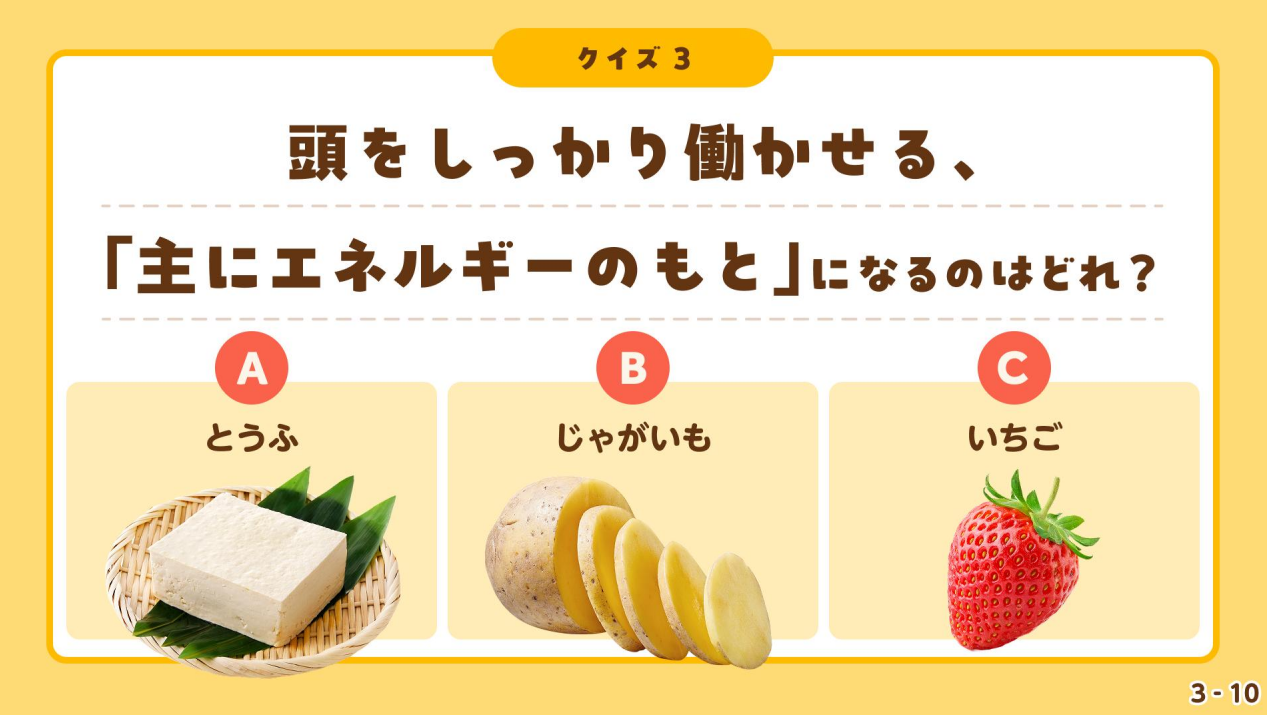
- 2The Role of Food
Through quizzes, children learn about the role of meals, the benefits of breakfast, and balanced eating.
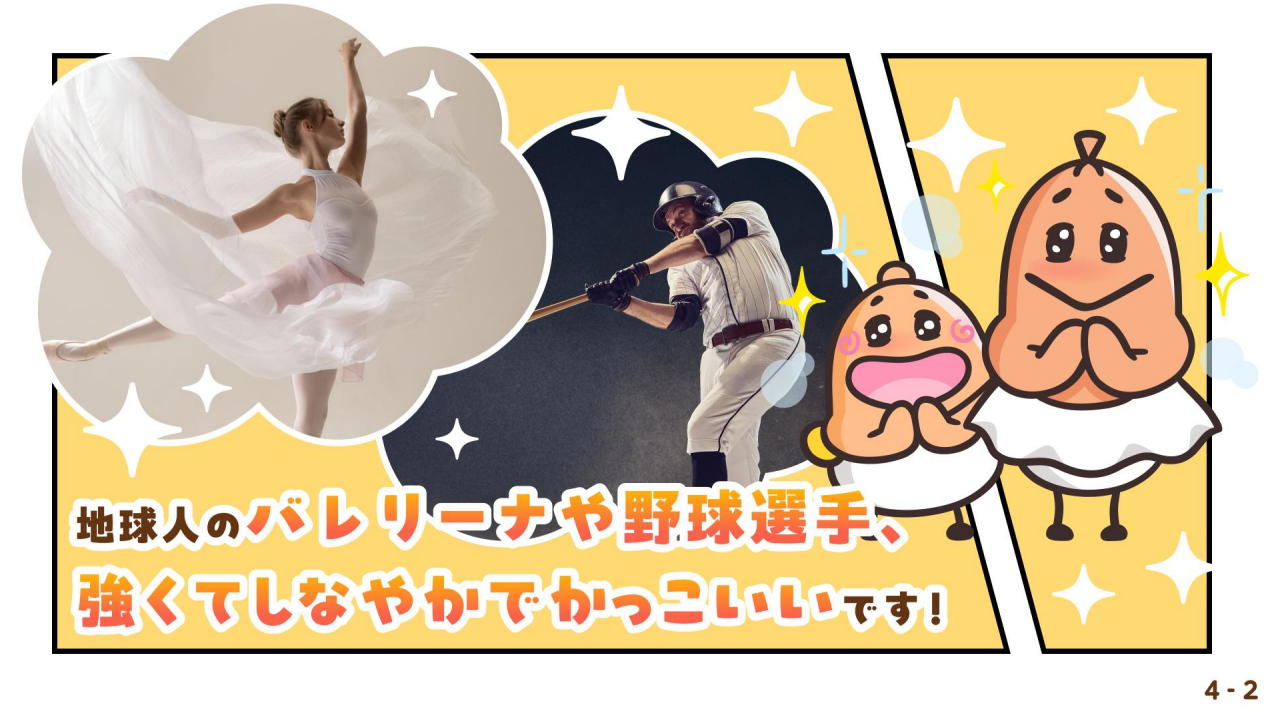
- 3Meals and Exercise
Together with our company characters, children learn about the relationship between meals, exercise, and sleep.
- 4The Journey to Store Shelves: Sausage Edition
This section introduces the process by which sausages are made.
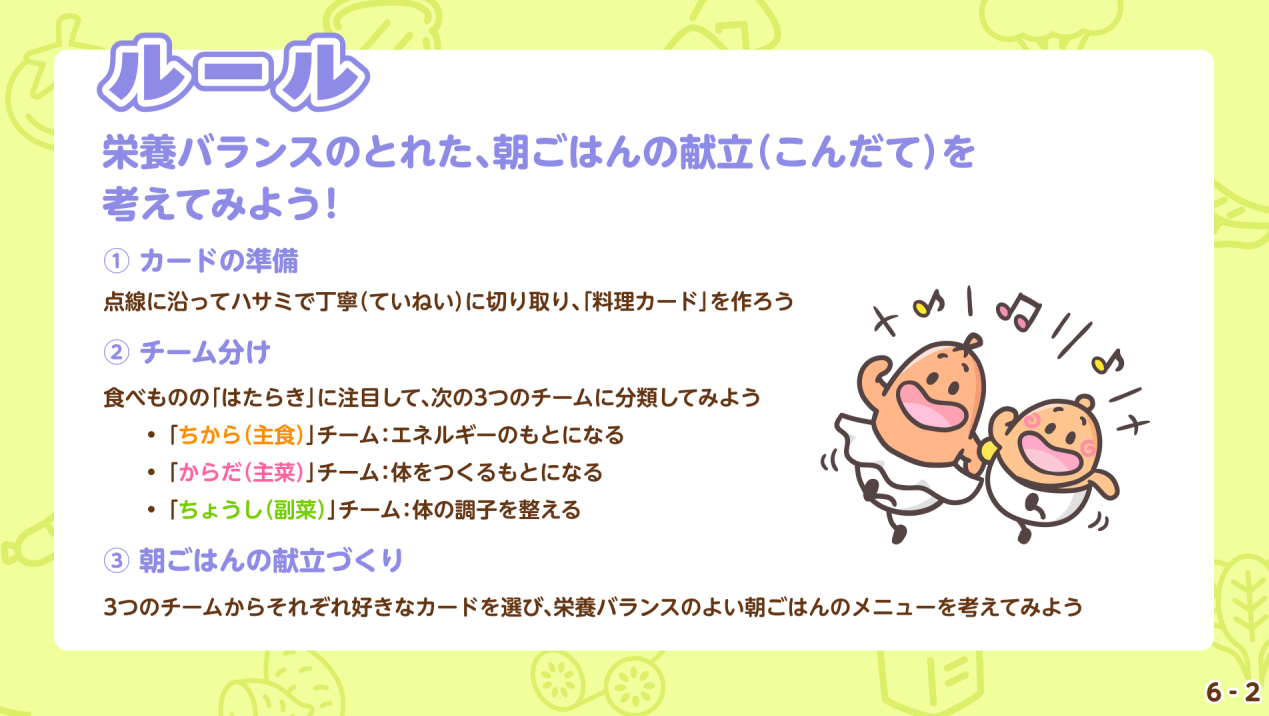
- 5Let’s Become Breakfast Masters [Group Work]
Using food cards, children learn how to create nutritionally balanced breakfast menus.
- 6Let’s Make It! Recommended Breakfast Ideas
This section offers breakfast suggestions that can be prepared even on busy mornings.
Materials Provided
- 1“Let’s Eat Breakfast” dietary education materials in electronic format (PowerPoint or PDF)
- 2A learning booklet on ham and sausages
- 3An original clear file
- *All materials are provided free of charge.
- *Items 2 and 3 are provided in quantities matching the number of applicants (the number of children in the class).
Eligible Participants and Other Details
- Details
Eligible participants - Upper elementary school students (5th and 6th grades)
- Required time
- 5 to 45 minutes (adjustable depending on the content used)
- Relevant subjects / units
- Home Economics: “Healthy daily life through breakfast,” “Let’s make tasty meals with ingenuity,” “Leave today’s meal to me,” etc. / Health: “Healthy living,” “Let’s practice healthy habits,” etc. / Special Activities: “Let’s think about a well-balanced breakfast,” etc. / Class activities, Health, etc.
- *Please note that if we receive a large number of applications for onsite classes, we may be unable to accommodate all requests.
The materials for dietary education "The Secrets of Preserved Foods"
This is a booklet format of food educational materials. Through the history of preserved food and how it is made, children can gain insight into the importance of food and how to appreciatively eat it without letting any go wasted.
- *This program only supports the provision of educational materials.
“The Secrets of Preserved Foods”
- 1What is preserved food?
Learn about the origins of preserved foods and how they came to be made.
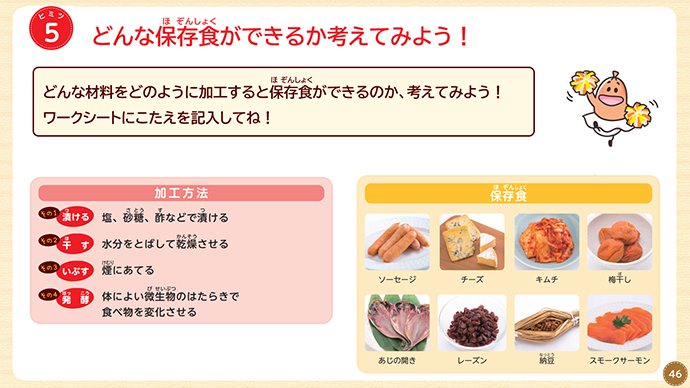
- 2Wisdom to make food last longer
Learn about traditional preservation methods (pickling, smoking, etc.).
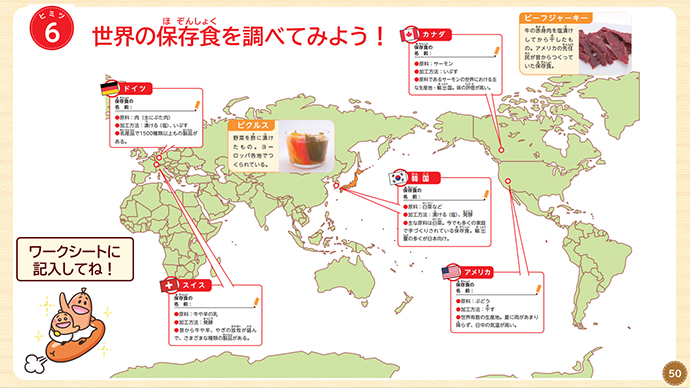
- 3Various preserved foods from Japan and the world
Various examples of preserved foods are introduced.
- 4Examples of preserved foods
Some examples of how preserved foods are made are introduced.
- 5Let’s think about what kind of preserved food we can make [Group work]
Discuss how and from what familiar preserved foods are made.
- 6Let’s check out Japanese preserved foods! [Group work]
- 7Let’s check out preserved foods from around the world! [Group work]
Learn about typical preserved foods from Japan and around the world.
Content of the provided education materials
- 1The Secrets of Preserved Foods (PowerPoint file)
- 2Dietary Education Materials about ham and sausages
- 3Original clear file folder
- *All are free of charge.
- *For 2 and 3, provided for the number of people indicated when the application was submitted (the number of students in the class) .
Target, etc.
- Target
- Upper elementary grades (5th to 6th grade)
- Time required
- 45 minutes
- Applicable subject/unit
- The Period for Integrated Studies (dietary education)
Social Studies: Climatic features of the country and people's lives
- Japanese version only
Onsite Class Program "Let's check in the Refrigerator!"
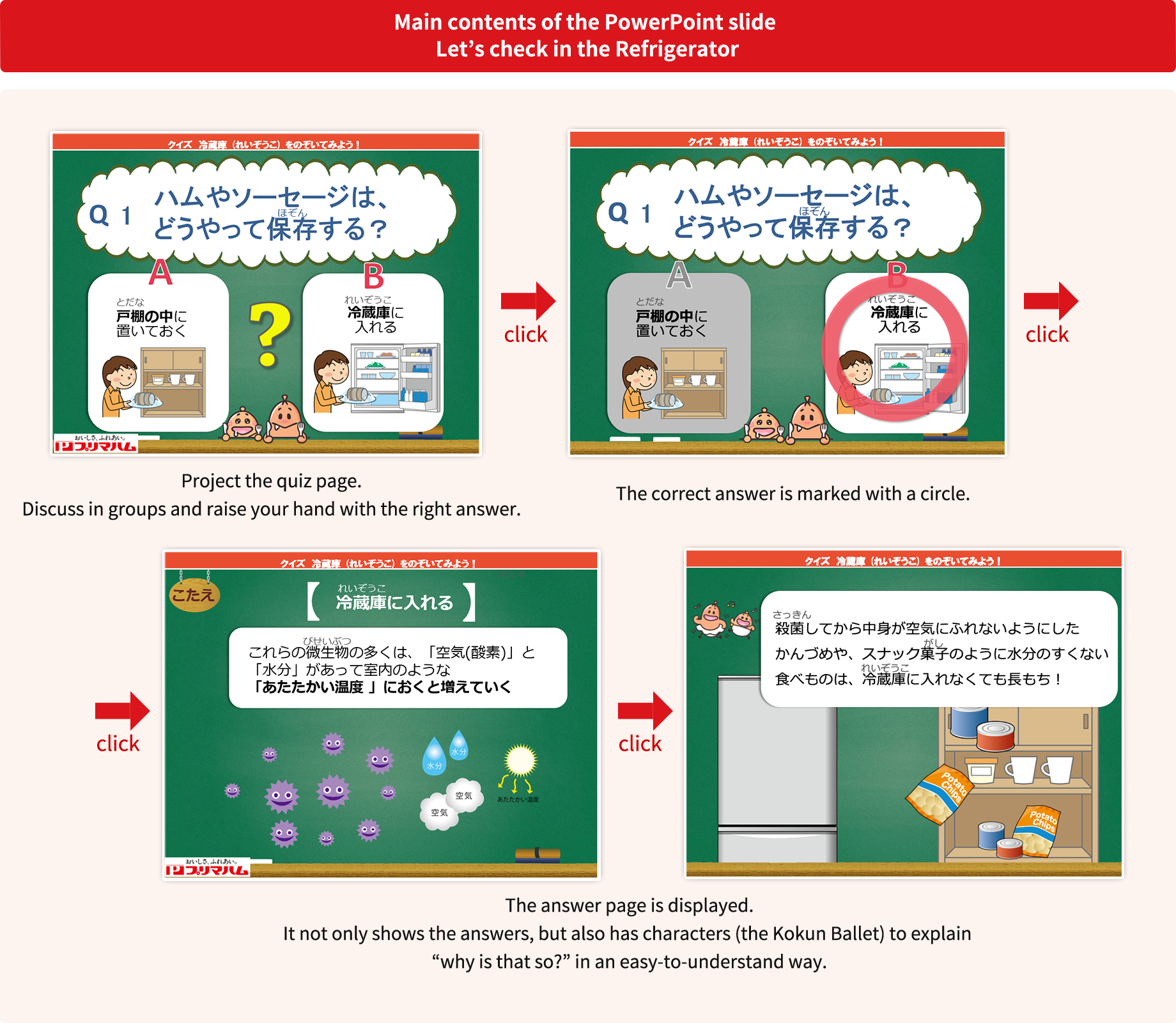
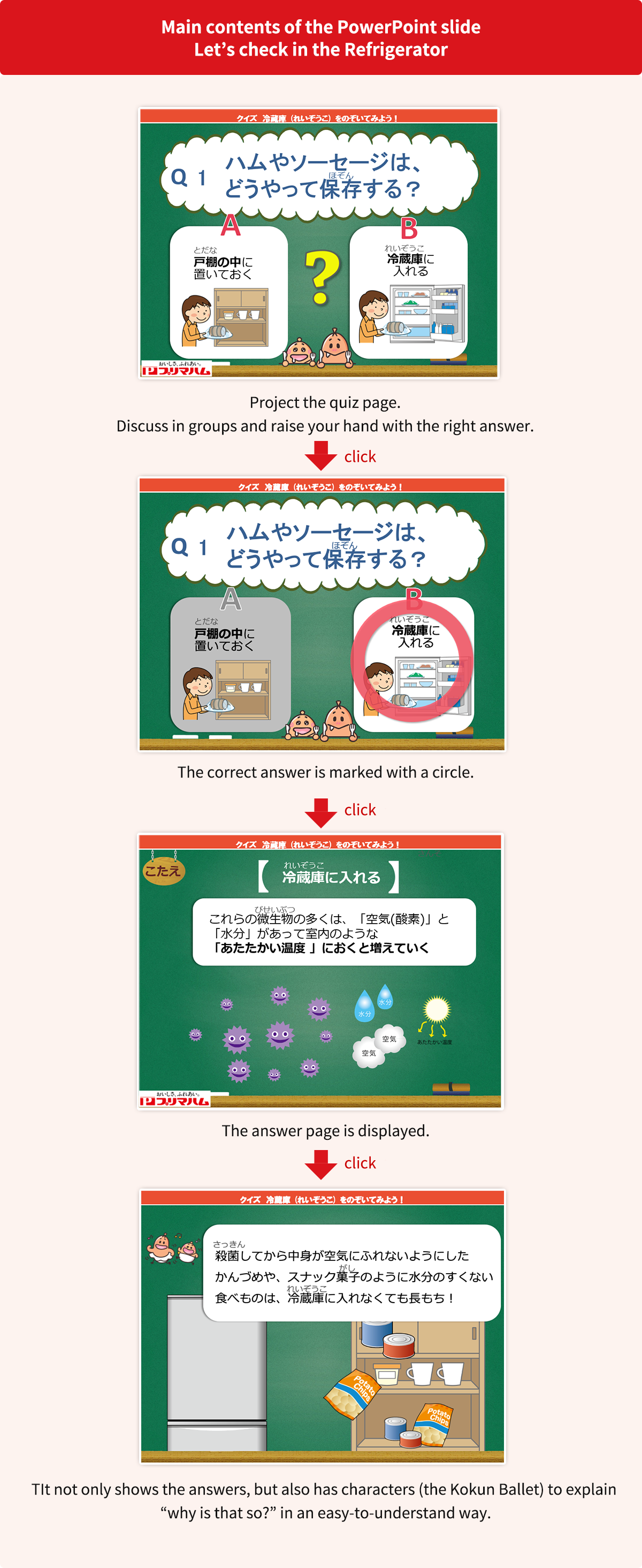
This is an Onsite Class Program in the form of a quiz utilizing slides. The theme of this course is “Food in the Refrigerator” and students will learn how to preserve food and gain basic knowledge about food labels.
- *This program only supports the provision of Onsite Class Program.
- Japanese version only
Flow of the Onsite Class Program
-
Our instructors will give a quiz about food using PowerPoint slides.
-
Each group discusses the answer (Yes/No) and the reason for it, and makes a presentation.
-
The instructor explains the correct answer and the reason for it (repeated for a total of 5 questions)
-
Review the class content and enjoy actually eating (the company’s products)
Outline of the education materials
- Format
- PowerPoint slides
- Composition
- Quiz (Yes/No questions), answers and explanations x 5 sets
- Time
- 45 minutes
Target, etc.
- Target
- Upper elementary grades (5th to 6th grade)
- Applicable subject/unit
- The Period for Integrated Studies (dietary education and environmental education)
Home Economics: I will cook for you today
- Sample products to try
- Koukun® Sausage,etc
* Available upon consultation
Dietary Education Support Office
Prima Meat Packers Dietary Education Support Office
e-mail:syokuiku@primaham.co.jp