
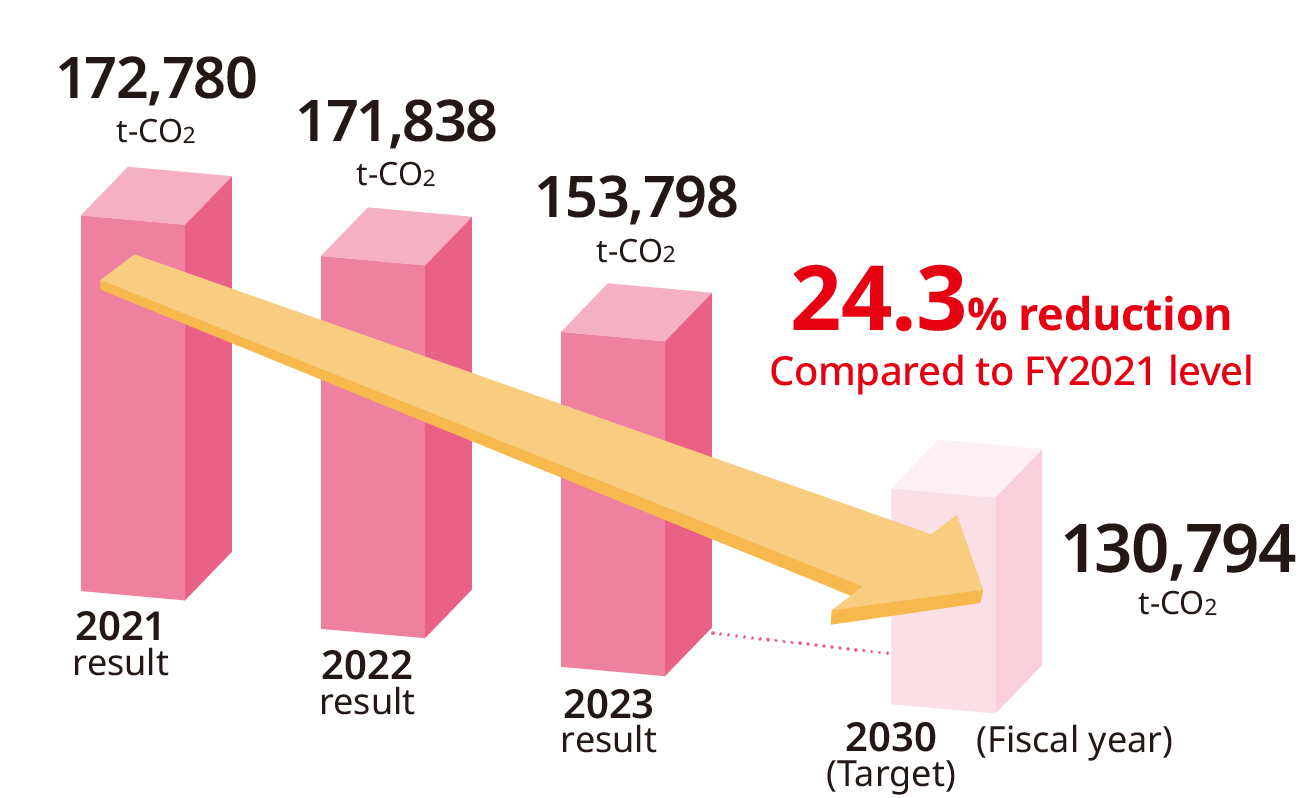
Reducing greenhouse gas emissions is one of our material issues. In fiscal 2022, the Board of Directors set a goal to reduce Scope 1 and 2 greenhouse gas emissions by 24.3% by fiscal 2030 from the fiscal 2021 level, excluding emissions from overseas sources and from livestock.
In fiscal 2024, greenhouse gas emissions were down 12.4% from the previous year’s level due to initiatives such as expanded procurement of renewable energy and the effects of investments in phasing out fluorinated refrigerants. We also calculated and disclosed our scope 3 emissions on a non-consolidated basis.
In addition to the existing goal of reducing Scope 1 and 2 greenhouse gas emissions by 24.3% by fiscal 2030 from the fiscal 2021 level, excluding emissions from overseas sources and from livestock, we have set a new goal to reduce emissions by 38.0% by fiscal 2035 from the fiscal 2021 level. This new goal covers the entire Group, including emissions from overseas sources and from livestock. We support Japan’s Nationally Determined Contribution (NDC) of reducing greenhouse gas emissions by 60% by 2035 from the fiscal 2013 level, as well as the agreements under the Paris Agreement, and our fiscal 2035 goal is aligned with the Japanese government’s target.
We have also formulated a roadmap for achieving our fiscal 2035 goal, based on expected technological advances and the introduction and strengthening of climate change-related regulations. Under the basic policy of our medium-term management plan, we are promoting management with an emphasis on sustainability, together with the expansion of both the scale and quality of sales and profits. The formulation of this roadmap represents one step toward achieving these objectives.
- *The 24.3% reduction (compared to the fiscal 2021 level) was determined by annualizing the Japanese government’s 2030 target of 46% reduction from the fiscal 2013 level.
Reduction target for GHG emissions at scopes 1 and 2 (excluding emissions from overseas sources and from livestock)
Environmental investment quota
Prima Meat Packers Group strategically sets an environmental investment quota. When assessing the profitability of decarbonization investments, we calculate the economic value of greenhouse gas reduction effects with reference to such factors as the cost of procuring renewable energy and a potential future international carbon tax (140 USD / t-CO2), and incorporate these effects into our decision-making.
Collaboration with industry associations and other organizations
Prima Meat Packers Group supports and complies with the Act on the Rational Use of Energy and Shift to Non-fossil Energy and the Act on Promotion of Global Warming Countermeasures. Every year, we work and communicate with policymakers by reporting to the relevant authorities on our energy consumption, progress toward reduction targets, and greenhouse gas emissions.
Our Group is a member of the Japan Food Industry Association and the Japan Ham & Sausage Processors Cooperative Association. On Friday, December 1, 2023, together with Itoham Yonekyu Holdings Inc., NH Foods Ltd., Marudai Food Co., Ltd., and the Japan Ham & Sausage Processors Cooperative Association, we announced the “Meat Processing Industry Declaration for Contribution to the SDGs and Sustainable Logistics.” We are implementing joint delivery and a review of delivery conditions. Through joint delivery, multiple companies consolidate product shipments, thereby improving truck loading efficiency and reducing the number of delivery trips. We are also promoting greater logistics efficiency by reviewing delivery conditions, including extending delivery lead times.
On October 7, 2024, with the aim of realizing sustainable chilled food logistics, we jointly launched the Chilled Logistics Study Group with eight other companies handling chilled foods: Itoham Yonekyu Holdings Inc., Nissin Foods Chilled Co., Ltd., Nissin York Co., Ltd., NH Foods Ltd., Marudai Food Co., Ltd., Meiji Co., Ltd., Morinaga Milk Industry Co., Ltd., and Megmilk Snow Brand Co., Ltd. The Chilled Logistics Study Group brings together stakeholders involved in chilled foods—including manufacturers, distributors, and logistics companies—to discuss the future of chilled food logistics. The group aims to realize sustainable chilled food logistics that can both solve logistics issues and reduce environmental impact while ensuring a stable supply of products to consumers.